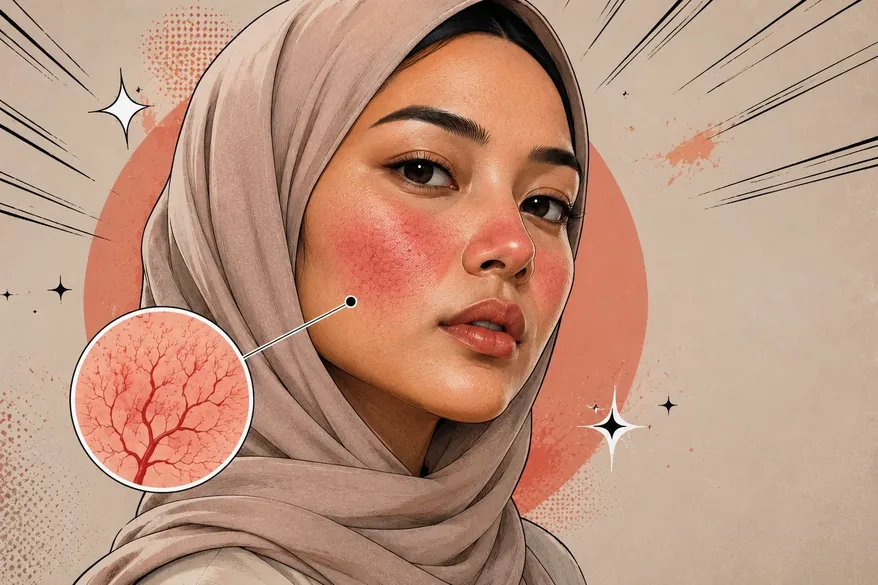
What is actually happening
Cross-section · vessel behaviour
One vessel, two states: at rest, and widened during a flush. Not to scale.
-
01Vessels open too easilyThe tiny vessels in the centre of the face widen fast and close slowly, so a flush lasts far longer than whatever set it off.
-
02Then they stop closingAfter enough flushes the vessels stay open. The redness never fully clears, and that is the part seen in photographs.
-
03The skin inflames easilyIn some people this brings bumps and pustules, which is why rosacea is so often mistaken for acne.
-
04The barrier is thinWater escapes faster and the nerves in the skin react to things that would not normally register, so products sting. Supporting the barrier is part of the treatment, not an extra.
Telling it apart
Two things get called red skin. One arrives with a cause and leaves on its own; the other stays and needs treating.
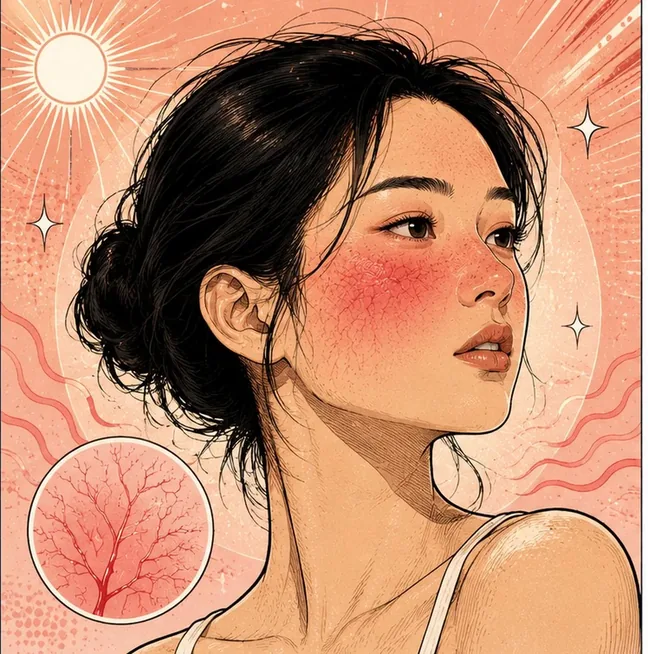
Rosacea
Reads as
Redness that stays, centre of the face, often with visible small vessels. Bumps and pustules in some people, and no blackheads.
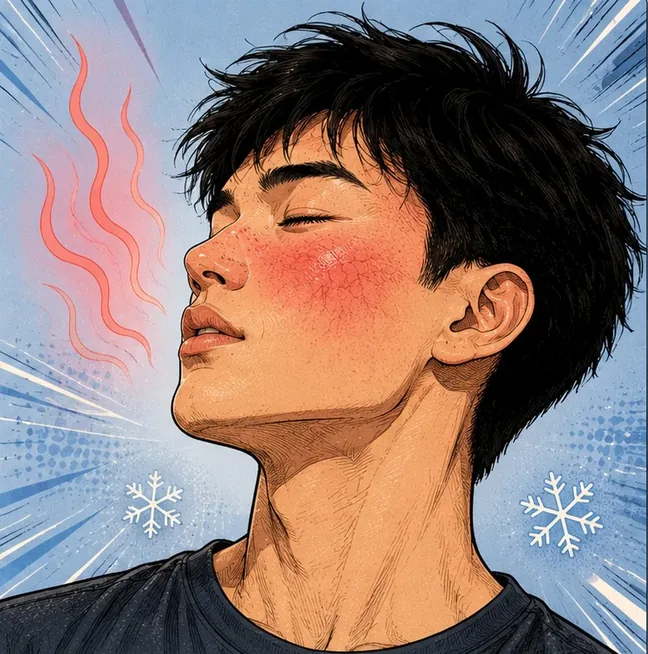
Flushing
OnsetPeakGone
Reads as
A wave of heat and colour that arrives with a cause and leaves on its own. Normal on its own. Repeated often, it can be the earliest sign of rosacea.
How long each one lasts
Flushing lasts minutes to an hour and goes. Rosacea runs for months to years, flaring on top of a redness that stays.
Time axis compressed, not to scale
What makes it worse
Most rosacea routines fail because they are too aggressive, not because they are too gentle. These are the reliable ways to make it worse.
-
Hot waterHot showers and hot flannels widen vessels directly. Lukewarm, every time, and no steaming the face.
-
Scrubs and brushesPhysical exfoliation on inflamed skin damages a barrier that is already struggling. There is no gentle version of a face brush here.
-
High-strength activesStrong glycolic peels and unbuffered retinoids are a common cause of a bad flare. Low concentration, low frequency, or not at all.
-
Alcohol-heavy tonersAstringent toners sting, strip and give nothing back. Skip the category.
-
Fragrance and essential oilsCommon irritants on reactive skin, and there is no benefit to the skin to offset it.
-
DIY anythingLemon juice, baking soda, apple cider vinegar. All of it is either too acidic or too alkaline, and it lands on the least tolerant skin type there is.
What actually helps
Over the counter
- 01A gentle cleanser, lukewarm waterNon-foaming, no scrub, hands only. Pat dry.
- 02A barrier moisturiser, twice a dayCeramides and glycerin. A calmer barrier stings less and flares less.
- 03Mineral sunscreen, every morningSun is the most commonly reported trigger. Zinc and titanium tend to sit better than chemical filters on reactive skin.
- 04Niacinamide, introduced slowlyCan settle redness and help skin tolerate more over time. Two or three nights a week first, on top of moisturiser if it stings.
Prescription only
There is a prescription option for each part of rosacea, and they work on different things. Which one fits, and in what order, is a doctor's call.
- Topical anti-inflammatories, for bumps and pustules
- Azelaic acid, for redness and bumps together
- Vessel-constricting topicals, for background redness. They wear off each day, and can leave the skin redder than before in some people
- A low-dose oral course, for stubborn inflammation
- Laser or light, for vessels no cream will clear
Why azelaic acid is in this column
Azelaic acid is written up overseas as something you can buy over the counter. In Singapore it is not: the Health Sciences Authority does not allow it in cosmetic products at any strength, so it belongs in this column.
Named products are left out on purpose. Which of these fits you is a conversation with a doctor
Red alert · see a doctor
Do not wait this out
- →Eye pain, sensitivity to light, or vision that has changed. Act on this one urgently. Rosacea can inflame the cornea, and that puts eyesight at stake.
- →Gritty, burning or watery eyes, or repeated styes. Rosacea can affect the eyelids and eyes with very little facial redness to go with it, and it still needs treating.
- →Skin on the nose thickening or coarsening. Early treatment matters here.
- →Bumps and pustules that do not settle after a few weeks of gentle care.
- →Sudden, severe redness with fever or feeling unwell. That is not a flare, get it looked at.
- →Everything you apply stings, including plain moisturiser.
Build a routine that suits reactive skin
The routine generator asks what your skin is doing, then names a cleanser, the actives worth trying, a moisturiser and a sunscreen that will not set it off.