Understanding the basics · UV protection

UV Protection 

Every part of this man's face is exactly the same age. The difference is how much ultraviolet light reached it over 28 years of driving a delivery truck.
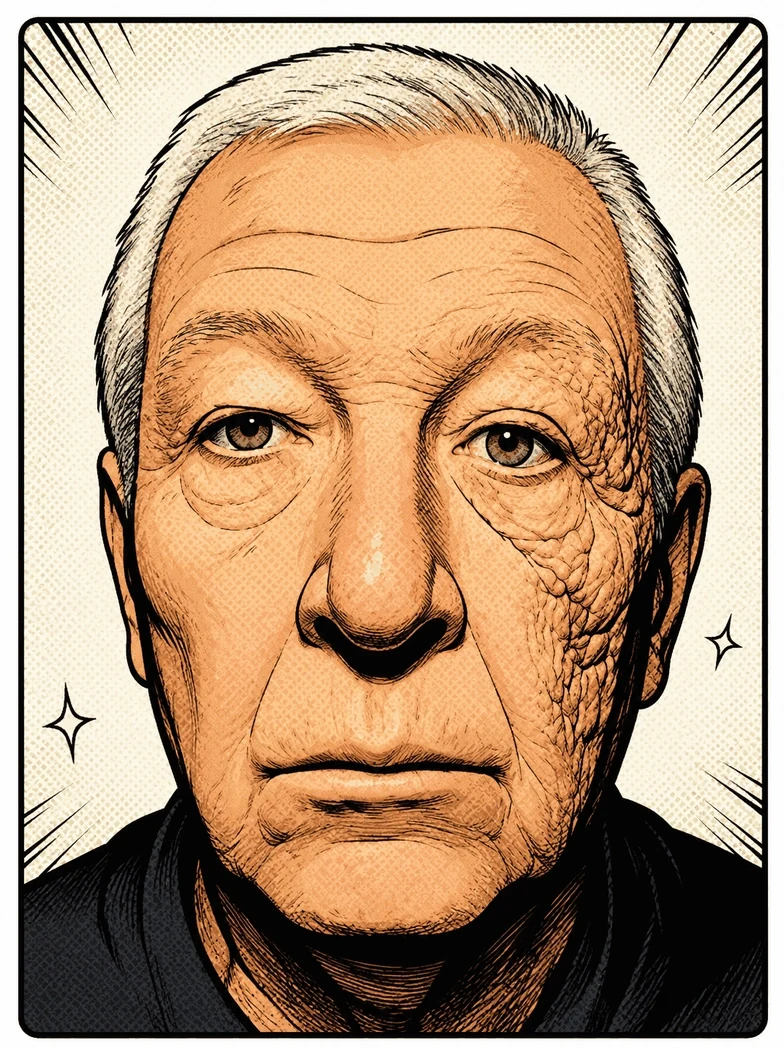
Kerb side · shaded
Smoother, Younger.
This is what ageing looks like with much less UV in it. Genetics, diet and time were identical on both sides of his nose.
Illustration of severe photoageing confined to one side of an older man's face
Illustration after a case published in the New England Journal of Medicine, 2012.
Window side · sun
Pigment, Wrinkles, Damage.
Sun damage can penetrate deeply and cause skin damage in the deep support layers of the skin.
How deep it goes

Three kinds of light

Why the depth matters

Each wavelength stops at a different depth, so each causes different damage: sunburn and DNA damage near the surface, lost collagen and elastin further down, and pigmentation deeper again. A sunscreen that only handles one of them leaves the rest of the work undone.

EpidermisUVB stops here
Dermis · collagen and elastinUVA reaches hereVisible light deeper still
Subcutis
UVB280–315 nm
UVA315–400 nm
Visible400–500 nm
UVB280–315 nm

Absorbed in the epidermis. Damages DNA directly, and causes sunburn.

SPF measures protection against this
What is Sun Protection Factor?
  • SPF is a UVB number. It describes how much longer skin takes to burn, and it says nothing about the wavelengths that reach the dermis.
  • SPF 30 filters roughly 97% of UVB; SPF 50, roughly 98% — measured under laboratory application.
  • That extra 1% is not the reason to choose 50.
  • Almost nobody applies the tested amount. Real-world application is usually suboptimal.
  • Apply less, and the protection you actually get falls with it.
UVA315–400 nm

Reaches the dermis. Degrades collagen and elastin, and passes through glass.

PA measures protection against this
What is PA (Protection Grade of UVA)?
  • PA is the Japanese grading for UVA protection, based on persistent pigment darkening.
  • More plus signs means more UVA held back — the wavelength doing the damage in the illustration at the top of this page.
  • PA+ to PA++++ is the whole scale. PA++++ is the top of it.
  • UVA varies far less than UVB across the day and the seasons, more of it gets through cloud, and it passes through glass — so this half of the label matters on days that do not feel sunny.
  • PA stops at 400 nm. Everything past that, including the visible light band here, is not on the label at all.
Visible light400–500 nm

Penetrates deepest; implicated in pigmentation, especially in deeper skin tones.

No rating exists
Why is there no rating?
  • SPF is a UVB measurement and PA is a UVA one. Neither scale goes past 400 nm.
  • There is no agreed test for visible light, so there is no number a manufacturer can print.
  • What covers it is decided by what is in the bottle, not by the label. That is what the section below is about.
Ingredients in sunscreen

Most bottles are a mix

The active ingredients in a sunscreen are its UV filters. There are three kinds, and one bottle often carries more than one — a hybrid is a mineral filter and a chemical one in the same formula. Every one of them absorbs ultraviolet: almost all of it is absorbed, not bounced. Where the three part company is visible light, and that is what the diagrams below show.

Mineral filter
Non-nano · leaves a white cast Nano · no white cast, “invisible”
UVB
UVA
Visible
≈95% absorbed
bounced back
passes through
Ultraviolet: both kinds absorb it. Almost all of it is absorbed, not bounced.
Visible light: only the opaque kind reflects it — and that reflection is the white cast. The nano kind lets it through.
Zinc oxide
Titanium dioxide
Advantages and disadvantages
Advantage: Does not sting the eyes.
Advantage: Well tolerated by reactive, rosacea-prone and post-procedure skin.
Advantage: The default while you are pregnant or breastfeeding.
Disadvantage: White cast, and heavier and oilier on the skin.
Disadvantage: The "invisible" nano formulas use particles small enough for visible light to pass through — no cast, and no cover either.
Chemical filter
UVB
UVA
Visible
absorbed → heat
Ultraviolet: absorbed in the film and released as a small amount of heat.
No cover. Visible light passes a chemical filter as if it were not there.
Avobenzone
Tinosorb
Uvinul
Octocrylene
Advantages and disadvantages
Advantage: Lightweight, with less white cast on every skin tone.
Advantage: Less oily, so people actually reapply.
Disadvantage: More likely to sting the eyes.
Disadvantage: Does not block visible light.
Disadvantage: Avobenzone breaks down in sunlight unless another filter in the formula holds it steady.
Mineral filter (iron oxide) · tinted
UVB
UVA
Visible
≈95% absorbed
Ultraviolet: almost all of it is absorbed, not bounced.
Taken in. Iron oxide absorbs it — in a skin shade, not in white.
Iron oxides
Tinted

A tinted sunscreen is a mineral one with iron oxide added — a pigment, not a UV filter. It blocks visible light in a skin shade rather than in white.

Advantages and disadvantages
Advantage: Covers visible light in a skin shade, without the white cast.
Advantage: Iron oxide is a mineral pigment. It absorbs visible light in a skin shade instead of reflecting it back in white.
Advantage: So two things on a label cover visible light: non-nano mineral and iron oxide. A tinted sunscreen usually carries both.
Advantage: This is the one to look for if you are dealing with melasma or dark marks.
Disadvantage: Only helps if the shade suits you.
How much, how often

Most people use too little

SPF is measured at an application thicker than most people apply. A rough guide for the face and neck is two lines of product along the length of the index and middle fingers — about half a teaspoon.

Reapply every two hours outdoors, and after swimming or heavy sweating.
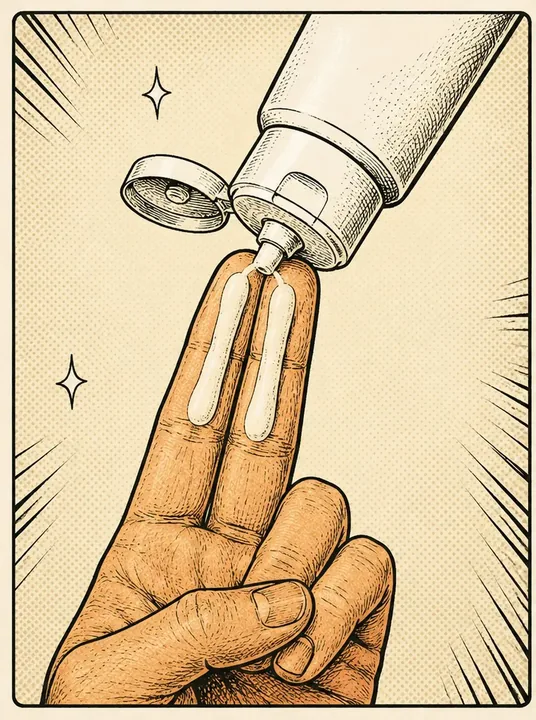
Broad-spectrum SPF 50, PA+++ or higher, every morning, whatever the weather.
Sunscreen squeezed from a tube as two lines running the full length of the index and middle fingers
Two full finger-lengths. That is one application for the face and neck.
What we would suggest
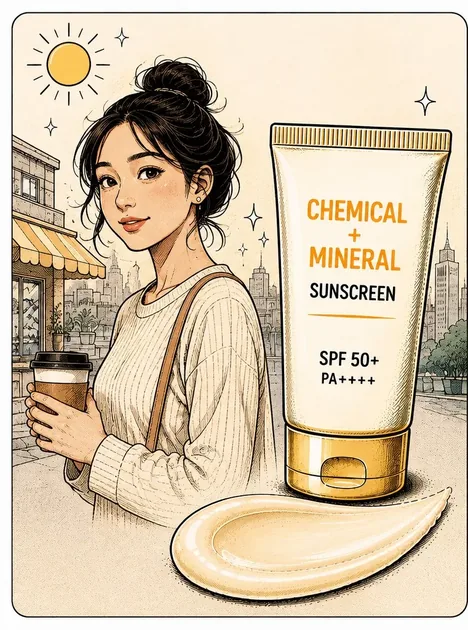
A person going about an ordinary day outdoors
Everyday
Chemical + mineral hybrid
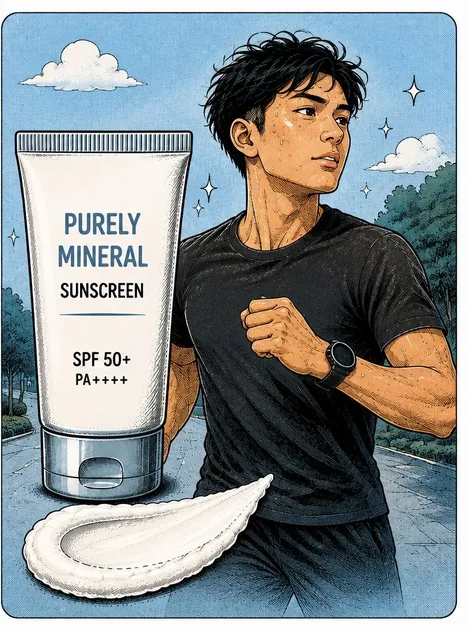
A person exercising outdoors in strong sun
Sport and heavy sweating
Purely mineral
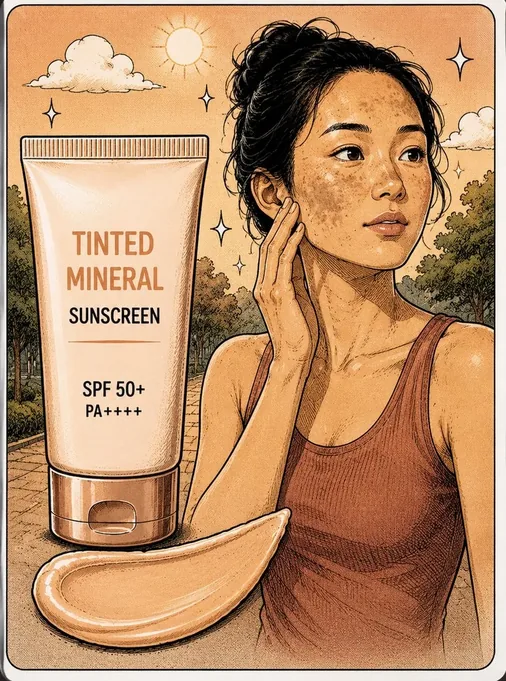
A woman with facial pigmentation applying a tinted mineral sunscreen outdoors
Pigmentation or melasma
Tinted mineral
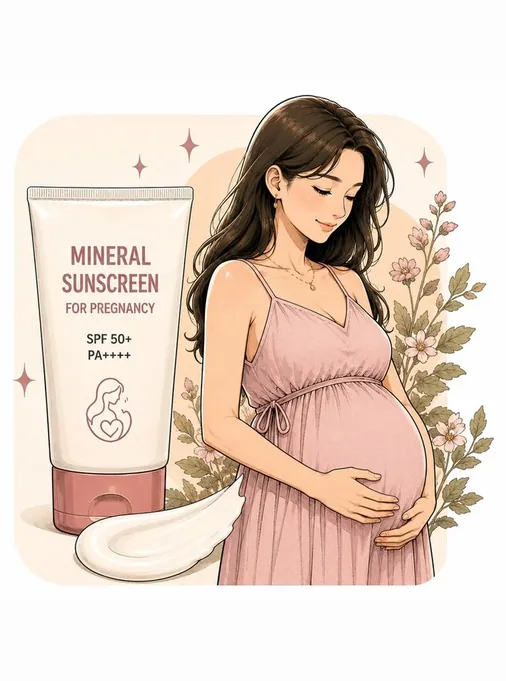
A pregnant woman holding a mineral sunscreen
Pregnant or breastfeeding
Purely mineral

These are kinds of sunscreen, not products. The Routine Generator works out which of them applies to you.

Find out which sunscreen you need

A few questions, and it names one of these for you, alongside the other three steps. Free, no account.

Start the Routine Generator